What If Your Horse Doesn't Need to Trust You Yet?
What If Your Horse Doesn't Need to Trust You Yet?
We put an enormous amount of pressure on the word trust. We want our horse to trust us when we approach, to trust us with their feet, their bodies, their fears, and eventually, perhaps, their backs. When they hesitate or move away, we often decide that we need to work on "building trust."
So we do exercises. We ask the horse to follow us, move around them until they turn toward us, retreat when they approach, or become more interesting, persuasive, and reassuring. Sometimes these things can be useful. But I've started wondering about something else:
What if trust isn't something we should be trying to make happen?
Maybe Your Horse Has Good Reasons Not to Trust You
Imagine meeting a complete stranger who immediately tells you that you should trust them. You don't know where they've come from, what they want, or whether they'll respect your boundaries or listen when you're uncomfortable. Would you trust them? Probably not.
Yet we sometimes expect horses to do exactly that. We walk into their space and expect them to accept our touch. We put on a halter and expect them to follow. We ask them to stand still, move forward, load into a trailer, carry us, or tolerate procedures they've never experienced before. When they hesitate, we may interpret it as a relationship problem.
But perhaps it's simply the reasonable response of an animal who doesn't know us yet.
Trust Doesn't Need to Be Rushed
A horse who keeps their distance isn't necessarily failing to connect with you. They may simply be gathering information. What do you do when I move away? Do you follow me? What happens when I stand still? Do you approach slowly? What happens when I say no? Do you listen? What happens when you don't get what you want? Do you become angry?
These are questions a horse can answer without saying a word. Every interaction gives them another piece of information about you, and over time those experiences become a history.
Perhaps trust begins long before the horse decides to trust you.
Stop Trying to Prove You're Safe
There's something slightly strange about the way we talk about earning a horse's trust. We often approach it as though we need to demonstrate our goodness to the horse: look how gentle I am, look how calmly I move, look how I can get you to follow me, look how quickly you can overcome your fear.
But the horse doesn't need a performance.
They need consistency.
They need to discover, over time, that what happens when you approach today is much like what happened yesterday. That moving away doesn't cause you to chase them. That saying no doesn't result in punishment. That your hands aren't always followed by something uncomfortable. That you don't suddenly become unpredictable when they don't do what you want.
Those experiences are much less exciting than a dramatic "trust-building" exercise. They're also much more convincing.
What If They Don't Come to You?
Let them stay where they are.
I know that's not always practical. Sometimes you need to catch your horse. Sometimes you have somewhere to be. Sometimes a horse needs medical care or must be moved for safety. But when you do have the luxury of choice, there is something worth learning from allowing a horse to keep their distance.
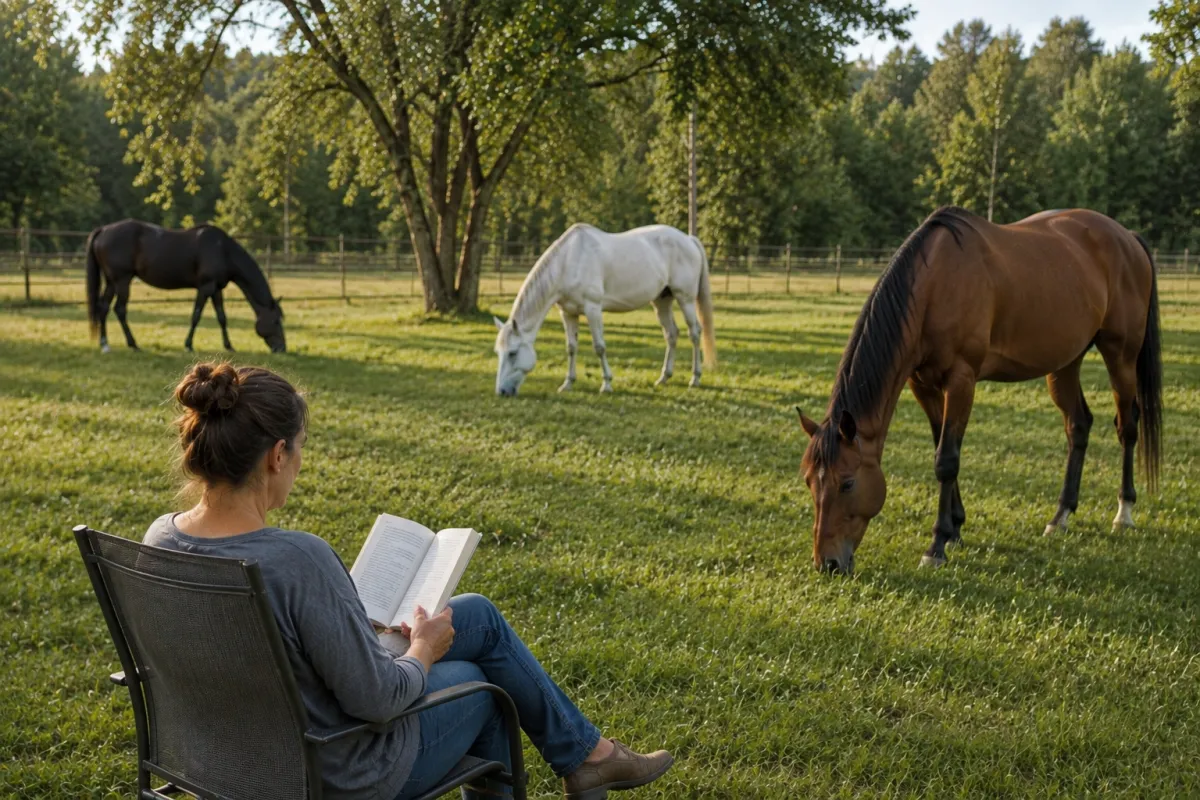
You get to see what they do when you're not pursuing them. Maybe they watch you. Maybe they go back to grazing. Maybe they gradually move closer. Maybe they come over after ten minutes. Maybe they don't.
All of those answers are information.
And if the horse doesn't come today, that doesn't mean you've failed. It may simply mean the relationship isn't ready for that yet.
Trust Is Built in the Boring Moments
I think we sometimes look for trust in dramatic moments. The horse follows us loose in the arena. The horse lowers their head. The horse walks into the trailer. The horse chooses to stand beside us. Those moments can be lovely, but trust is probably built in much less glamorous places.
It's built when you consistently notice the horse's discomfort, when you don't punish them for being afraid, when you keep your promises, and when your behavior makes sense to them. It's built when they discover that you don't have to control every interaction.
Over time, the horse develops a history with you.
And that history becomes the evidence.
The Horse Doesn't Have to Trust You Today
This may be the part we struggle with most. We want the relationship now. We want the horse to come to us now, relax with us now, and accept us now. But perhaps giving a horse permission to not trust us yet is one of the first genuinely trustworthy things we can do.
You don't have to force closeness in order to create connection. You can give the horse time to become curious, let them observe you, make yourself predictable, listen when they ask for space, and allow the relationship to develop at a pace that belongs partly to the horse.
You don't build trust by convincing a horse to trust you. You build it by becoming someone they eventually have no reason not to trust.
And maybe that's a much better goal than getting a horse to trust us quickly. Real trust isn't something we can demand, train, or perform.
It's something another being decides to give us.
And that makes it infinitely more meaningful when they do.


