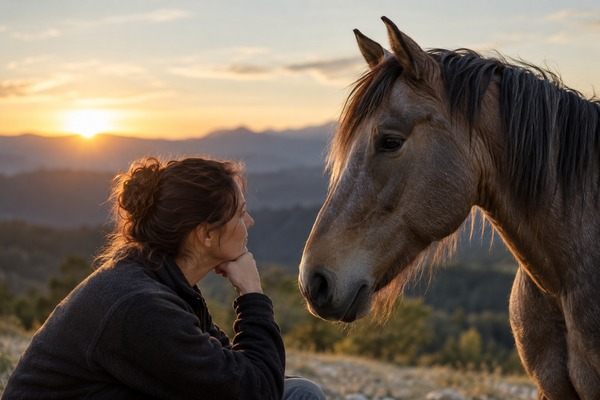
The Kindest Way to Control a Horse
The Kindest Way to Control a Horse
Sometimes the ideas that deserve the most scrutiny aren't the ones that sound harsh or extreme. They're the ones that sound so reasonable, compassionate and open-minded that we don't notice the philosophy underneath them.
I recently read a thoughtful post about bits. The author suggested that people who love bits should become competent and respectful with bitless work, while bitless advocates should become sufficiently knowledgeable and skilled with bits to understand how they might be used fairly, ethically, and perhaps even beneficially. The author described being taught to ride bitless for years before ever being offered a lesson in a bit, and how seriously their mentors treated the potential for harm.
On the surface, I find very little to disagree with. Don't be dogmatic. Don't assume your preferred method is the only ethical one. Understand what you oppose. Become skilled. Learn to use tools responsibly. Respect people who make different choices.
But the longer I sat with it, the more I wondered whether there was a wolf hiding underneath all those sheep's clothes.
The wolf isn't the bit. It isn't even the idea that people should become educated about bits. The wolf is the underlying assumption that the human gets to decide what should happen with the horse, and that the primary ethical question is how skillfully, carefully or kindly the human can accomplish it.
That is a very familiar philosophy of horsemanship, even when it is expressed in beautiful, compassionate language.
The bit becomes a morally neutral tool. The person's intentions matter. Their skill matters. Their timing matters. Their hands matter. Their knowledge of the horse matters. And certainly, all of those things matter if we have already decided that using the tool is appropriate.
But there is a question that comes before all of that: why is the human the one deciding that this is something the horse should be doing?
That question changes the entire conversation.
If my goal is to ride, then I can spend years becoming more subtle, more sensitive and more skilled at riding. I can learn to use less pressure. I can learn to recognize tension earlier. I can learn to use a bit with extraordinary care. I can become a vastly better horseperson.
But none of that necessarily changes the fact that I chose the goal.
And this is where I think we need to be careful with the increasingly sophisticated language of modern horsemanship. We talk about listening, communication, connection, softness, choice, partnership and respect. Those are beautiful things. But beautiful language doesn't necessarily mean the underlying relationship has changed.
We can become incredibly good at listening to a horse while still treating the horse's answer as negotiable. We can become extraordinarily skilled at imposing less without ever questioning whether we should be imposing at all. We can learn to recognize the horse's discomfort and become better at modifying our technique, while never considering that the horse might be communicating that it doesn't want the activity itself.
That is the part that interests me.
Because I don't think the answer to every disagreement is to become competent with the thing we disagree with. Understanding something doesn't require us to incorporate it into our own practice. In fact, sometimes learning more about something makes our opposition stronger because we understand more clearly why it doesn't align with what we value.
Nor do I think respecting another person's humanity requires me to consider every choice they make with a horse ethically acceptable. I can respect someone deeply as a human being while still disagreeing profoundly with what they believe they are entitled to ask of a horse.
And I don't think the goal should necessarily be to reach a future where everything we once opposed becomes something we respect.
Perhaps sometimes the goal is to become more discerning—to understand the difference between something being skillfully done and something being ethically justified.
That distinction matters.
A highly skilled person can perform an action beautifully. They can minimize discomfort, anticipate responses, read body language and use extraordinary subtlety. But competence doesn't automatically make the underlying choice ethical. It simply means the person has become very good at doing what they have chosen to do.
So perhaps the question isn't whether the bit can be used ethically.
Perhaps the question isn't even whether riding can be done ethically.
Perhaps the deeper question is what kind of relationship are we actually trying to create with horses?
Is the horse ultimately there to participate in the life we have designed for them, with increasing degrees of kindness and choice along the way? Or are we willing to create relationships in which the horse's preferences can genuinely change the direction of the relationship?
Can the horse say, “I don't want to do this,” and have that answer matter?
Can the horse choose something else without being corrected, persuaded or trained out of the preference?
Can the horse walk away from the activity without the human simply becoming more creative about how to get the desired response?
Those questions take us somewhere very different from the bit-versus-bitless debate.
And perhaps that is why this kind of argument can be so persuasive. The wolf doesn't arrive looking like domination. It arrives wearing the language of kindness. It says, Be open-minded. Become more skilled. Understand other perspectives. Don't judge. Use the tools ethically.
All of those things can be good advice.
But if, underneath the language, the human remains the one who decides the destination and the horse's role is simply to have a more pleasant journey there, then the fundamental relationship hasn't changed very much.
Maybe we need to become less interested in finding the kindest possible way to get horses to do what we want, and more interested in what happens when what the horse wants becomes important enough to change what we want.
That, to me, is a much more radical idea.
And perhaps that's where we finally discover whether the sheep's clothing is actually hiding a wolf.


