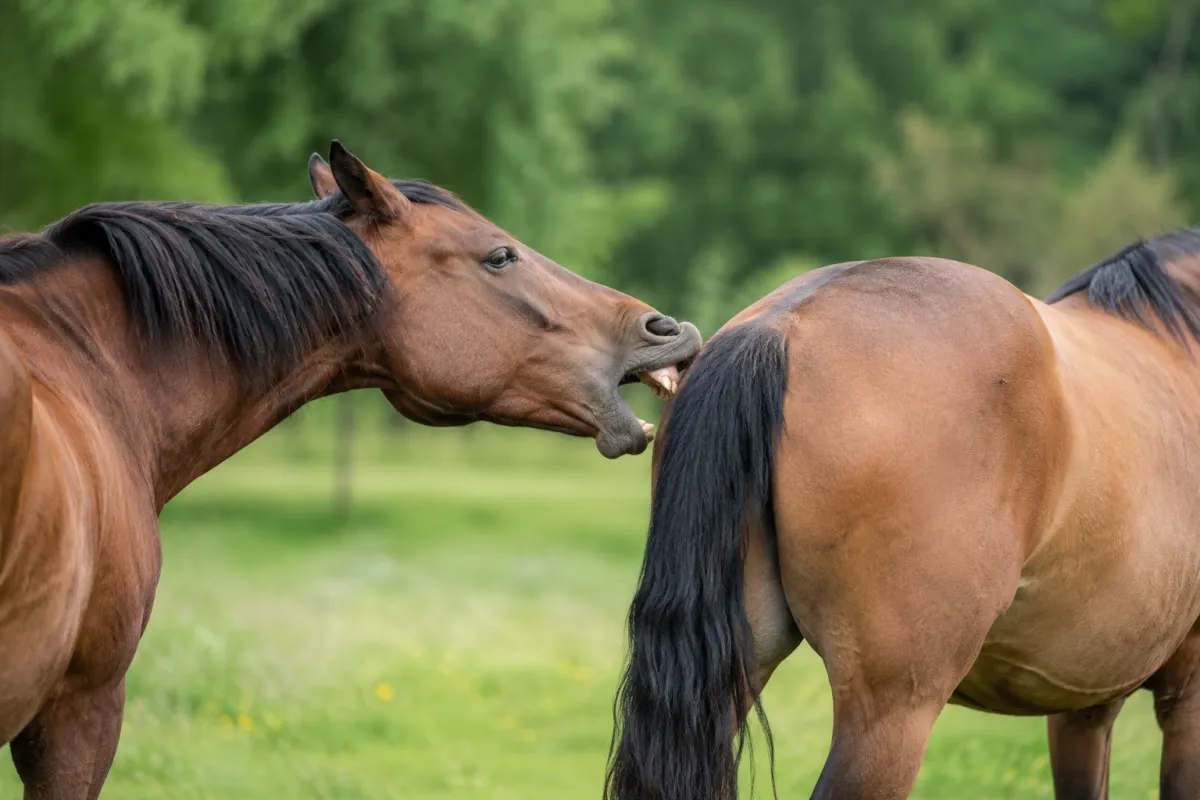
Why Does My Horse Bite?
Why Does My Horse Bite?
If you ask why a horse bites, you'll probably hear some familiar answers.
He's dominant.
She's disrespectful.
He's testing you.
She's spoiled.
He knows better.
He needs to learn that biting humans is unacceptable.
Sometimes the advice is even simpler:
Hit him before he hits you.
I think we're asking the wrong question.
Instead of beginning with "How do I stop my horse from biting?" I think we should begin with:
"Why does this horse feel the need to bite?"
That small change in the question changes everything.
The Bite Is Not the Beginning
A horse rarely goes from perfectly comfortable to biting without anything happening in between.
There is usually a story.
Maybe something hurts.
Maybe the horse is frightened.
Maybe they're confused.
Maybe they're being asked to do something they don't understand.
Maybe they don't want to be touched in a particular place.
Maybe they need more space.
Or maybe they've already tried telling us all of those things in quieter ways.
A turn of the head.
A tightening around the eye.
A wrinkle of the nostril.
A shift of weight.
A step away.
A pinned ear.
A change in breathing.
A horse can communicate quite clearly without ever opening their mouth.
The problem is that we often don't notice.
Then the horse makes the message bigger.
And suddenly we're paying attention.
What If the Bite Is Communication?
This doesn't mean every bite has the same meaning.
It doesn't.
A horse may bite from fear, pain, frustration, confusion, defensiveness, play, exploration, or a learned pattern of behavior.
Context matters.
The point is to stop assuming that the meaning is disobedience.
Look at What Happened Before
If your horse bites when you tighten the girth, that's information.
If they bite when you touch a particular part of their body, that's information.
If they bite when you approach their stall, that's information.
If they bite when you ask them to move away from their friends, that's information.
If they bite only after you've ignored several attempts to create distance, that's information too.
Ask yourself:
What happened immediately before the bite?
And then ask an even harder question:
What did my horse do before that?
The answer may take you much further than trying to correct the bite itself.
A Horse Doesn't Need to Be Dangerous for Their Message to Matter
There's an important distinction here.
A horse can communicate in a way that is unsafe.
We don't have to pretend otherwise.
A horse capable of biting or kicking can seriously injure a person, and safety has to come first.
If you don't feel safe, create distance.
Use a fence or other barrier when appropriate.
Don't put yourself in a situation where you're relying on the horse to make the right decision.
Get qualified help when necessary.
And investigate possible physical causes with appropriate veterinary care.
Respecting what a horse is communicating does not mean ignoring danger.
It means taking the communication seriously while also protecting everyone involved.
What Happens When We Only Correct?
Suppose a horse bites because they're frightened.
We punish the bite.
The horse stops biting.
Have we solved the fear?
Suppose the horse bites because something hurts.
We punish the bite.
The horse stops biting.
Has the pain disappeared?
Suppose the horse bites because they've learned that quieter signals don't work.
We punish the bite.
What have they learned now?
Perhaps only this:
Don't let the human see what you're feeling.
That's a very different outcome from creating trust.
A suppressed behavior can look like improvement while the underlying problem remains.
Sometimes the Kindest Response Is to Walk Away
This is something I've come to believe strongly.
If a horse is telling me they don't want me in their space, I don't always need to win that interaction.
Sometimes I can simply leave.
Not because the horse is in charge.
Not because I've been defeated.
Because I don't need to turn every disagreement into a contest.
Space can be an answer.
Time can be an answer.
Listening can be an answer.
And sometimes, after the pressure is removed, the horse tells us much more than they could have told us while defending themselves.
What About the Horse Who Keeps Coming After You?
This is where the idea becomes more complicated.
If a horse continues pursuing a person with the intention of biting or kicking, walking away may not be enough to keep someone safe.
We shouldn't turn a philosophy of listening into a dangerous rule.
Create distance.
Get behind a barrier.
Use appropriate protective equipment if you must enter the horse's space.
Get help from someone experienced with genuinely dangerous behavior.
And then ask why the horse has learned that attacking a human is necessary or effective.
The goal isn't to prove that the horse is right.
The goal is to understand what has created the situation.
The Goal Isn't a Horse Who Never Says No
I don't want a horse who has simply learned that saying no is dangerous.
I want a horse who can say no early.
Quietly.
Clearly.
And who has learned that I will notice.
Because the goal isn't to eliminate disagreement.
The goal is to make disagreement safe.
Listen Before the Teeth
A bite is a dramatic message.
But it may be the least interesting part of the conversation.
Watch what happens before it.
The hesitation.
The tension.
The retreat.
The ear.
The breath.
The glance.
The tiny movement that happened three seconds before the teeth appeared.
That's where the real conversation may be.
And perhaps the most important question isn't:
"How do I stop my horse from biting?"
Perhaps it's:
"What would need to change so my horse no longer feels that biting is necessary?"
That's a much harder question.
But I think it's a much more useful one.
If you want to explore this way of thinking more deeply, Autonomous Horsemanship is the philosophy I've developed around listening to horses, respecting their agency, and changing our own behavior before demanding that they change theirs.


