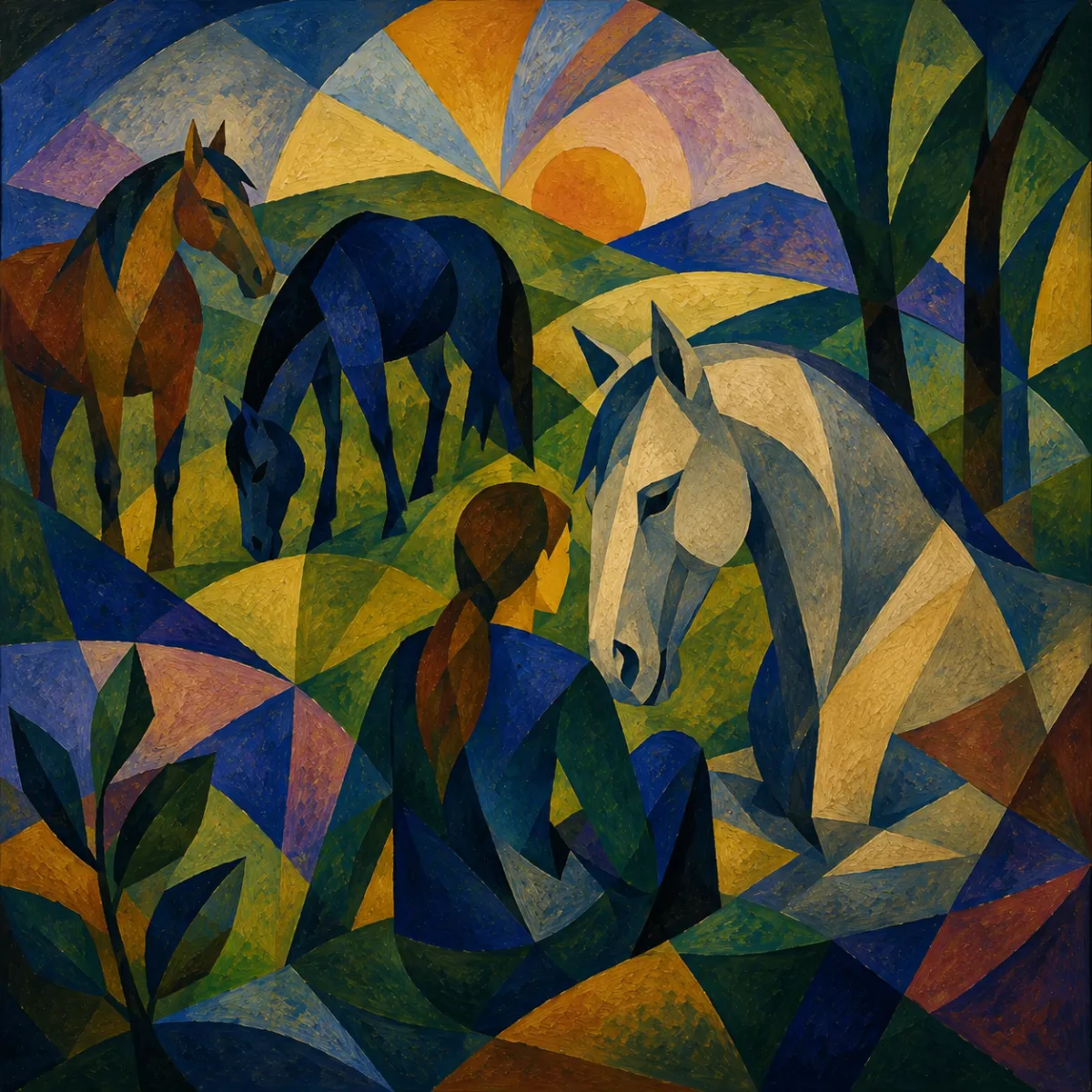
What My Horses Taught Me By Never Being Ridden
What My Horses Taught Me By Never Being Ridden
Somewhere in nearly every conversation I have about my horses, there's a moment where the other person waits for the part where I mention riding. It doesn't come. And I can watch, almost in real time, a small recalibration happen behind their eyes — like they're trying to figure out what the rest of the sentence is for, if not that.
I get it. In most of the world I grew up in, "I have horses" and "I ride" were the same sentence. The horse was, structurally, a vehicle with a heartbeat — extraordinary, deserving of care and respect, but still fundamentally for something. You fed him, you groomed him, you built a relationship with him, and all of that was in service of the actual point, which was getting on his back and going somewhere.

I don't ride. Haven't in years. And I've come to think that decision didn't just remove an activity from my life with horses — it removed a whole hidden architecture of assumptions I didn't know I was carrying.
The question I didn't know I was avoiding
For a long time, if you'd asked me what a horse was "for," I would have given you an answer about partnership, about the beauty of moving together, about mutual trust built through work. It's a good answer. A lot of riders mean it sincerely, and I don't think they're wrong to.
But underneath that answer was a structure I never examined: the relationship existed to produce something. Trust was the means. Riding was the end. And every interaction, even the sweet unhurried ones — the grooming, the standing together, the quiet moments in the field — existed a little bit in service of that eventual goal, whether I said so out loud or not.
Once riding was off the table entirely, that structure had nothing left to organize itself around. And I had to sit with a question I'd never actually had to answer before: what is this relationship for, if not building toward anything?
What was left when the goal disappeared
The honest answer, at first, was: I didn't know. There was a strange, almost disorienting period where I'd go out to be with a horse and feel a kind of purposelessness I wasn't used to. No skill to build. No goal for the session. No metric of a "good" visit versus a less good one. Just two beings in a field, one of whom kept looking at me like he was waiting to find out why I was there.
What I slowly learned is that the purposelessness wasn't a void. It was space. Space I hadn't known was occupied by an agenda until the agenda was gone.
Into that space came things I don't think I would have noticed otherwise. The particular way one of my horses greets the morning — not me, the morning itself, the light changing, before he's even registered I'm there. The specific choreography two horses fall into when they groom each other, the give and take of it, the fact that it has rules I only understood after years of watching. The moments a horse chooses to stand near me for no reason I can identify, and the moments he chooses not to, and how much information is actually in that choosing once I stopped needing it to mean something in particular.
None of that required a saddle. None of it was leading toward a ride I was quietly building skills for. It was just what happens between a person and a horse when the whole relationship isn't structured around eventually asking him to carry you somewhere.
What I stopped doing, without meaning to
I noticed, later, that certain habits had quietly disappeared. I'd stopped evaluating horses by the things that matter for riding — the ones people ask about reflexively, "is he broke," "how's he handle," "would he make a good trail horse." Those questions used to shape how I saw a horse before I'd even really met him. Without riding as the frame, I found myself asking different things entirely: what does he seem to want. What is he like with other horses when no one's managing the interaction. What does he do with unstructured time.
I'd also stopped, without noticing exactly when, thinking of "good with people" and "easy" as compliments. A horse who does what's asked, promptly, without complaint — under the old frame, that was the goal. Under this one, I started to wonder what that ease was actually made of. Sometimes it's genuine comfort. Sometimes, I've come to believe, it's a horse who's learned that objecting doesn't change anything, so he's stopped objecting. Riding-oriented evaluation has no real way to tell those two things apart, because from the saddle, they perform identically.
What the horse gets to be, instead
Here's the part I didn't expect. Without a destination the relationship was building toward, the horse stopped being, even subtly, a project. He got to just be a horse — with preferences, moods, a social life with the herd that has nothing to do with me, days he wants company and days he clearly doesn't. I'm not shaping him toward a version of himself that's more useful to me. I'm watching a version of himself that was already there, that I simply hadn't been positioned to see clearly, because I'd always been looking at him partly as a means to an end.
I don't say any of this to argue riding is wrong, or that everyone who rides is missing something I'm not. Plenty of riders have real, unromanticized, deeply attentive relationships with their horses — riding doesn't automatically foreclose any of what I'm describing. But I do think it's worth naming what riding quietly assumes, because most of us never examine it: that the relationship is, at some level, in service of an activity. Remove that assumption entirely, even just as an experiment, and you find out how much of what you thought was "about the horse" was actually about the thing you were eventually going to do with him.
What's left, in the end
What's left, for me, is something harder to describe at a barn and much easier to describe in a field at dusk, watching a horse decide, entirely on his own, to walk over and stand near me for a while.
It's not less than what riding offers. It's not more, either — I want to be careful not to trade one hierarchy for another. It's just different, and it took years of not riding to find out what "different" actually contained. Turns out, quite a lot.


