What Is My Horse Trying to Communicate?
We often talk about learning to "read" horses, as though horses have a secret language and our job is to memorize the dictionary. Ears back means angry. Head down means relaxed. Tail swishing means irritated. Looking away means disrespect. Some of these observations can be useful, but horses aren't really speaking in a collection of fixed signals. They're communicating continuously, with their whole bodies, and what a particular movement means depends on the horse, the situation, and what happened just before it.
So instead of asking, "What does that signal mean?" I think a better question is:
"What is my horse experiencing right now?"
Start With the Whole Horse
Before focusing on an ear, a tail, or a facial expression, look at the entire horse. How are they standing? Where is their weight? What are their muscles doing? How are they breathing? Where is their attention? Are they moving toward something, away from something, or simply standing comfortably?
A horse can have their ears back while remaining completely relaxed. Another horse can have their ears forward while their entire body is tense. The individual signal is only one piece of the conversation. Think of it less like reading a word and more like listening to a sentence.
Pay Attention to What Happened Before
One of the most useful questions you can ask is:
"What happened right before this?"
Your horse turns away when you reach for the halter. What happened immediately before that? They pin their ears when you tighten the girth. What happened immediately before that? They suddenly become tense when you walk toward them. What happened immediately before that?
Behavior rarely appears out of nowhere. Often, the answer is sitting in the few seconds before the behavior we noticed. And sometimes that means realizing that the behavior we thought was the beginning of the conversation was actually the end of one. The horse may have already tried several quieter ways of saying the same thing.
Learn to Notice the Small Things
A horse doesn't usually begin by shouting. They might shift their weight, pause, turn an ear, tighten their jaw, hold their breath, move one step away, or simply look toward you and then look away. These tiny changes are easy to miss, especially when we're focused on what we want to accomplish.
But if we become better at noticing them, we may discover that our horse has been communicating with us all along. The goal isn't to become a perfect interpreter. It's to become a better listener.
Context Changes Everything
A horse who walks away from you in a pasture may be asking for space. Or they may simply be going somewhere else. A horse who pins their ears when another horse approaches may be warning them away. A horse who pins their ears while being saddled may be communicating discomfort.
The same outward behavior can have very different meanings depending on what is happening around it. This is why I don't like rigid rules about horse body language. There is no universal dictionary that allows us to translate every movement perfectly. We have to pay attention to the individual horse.
What Happens When You Stop Asking?
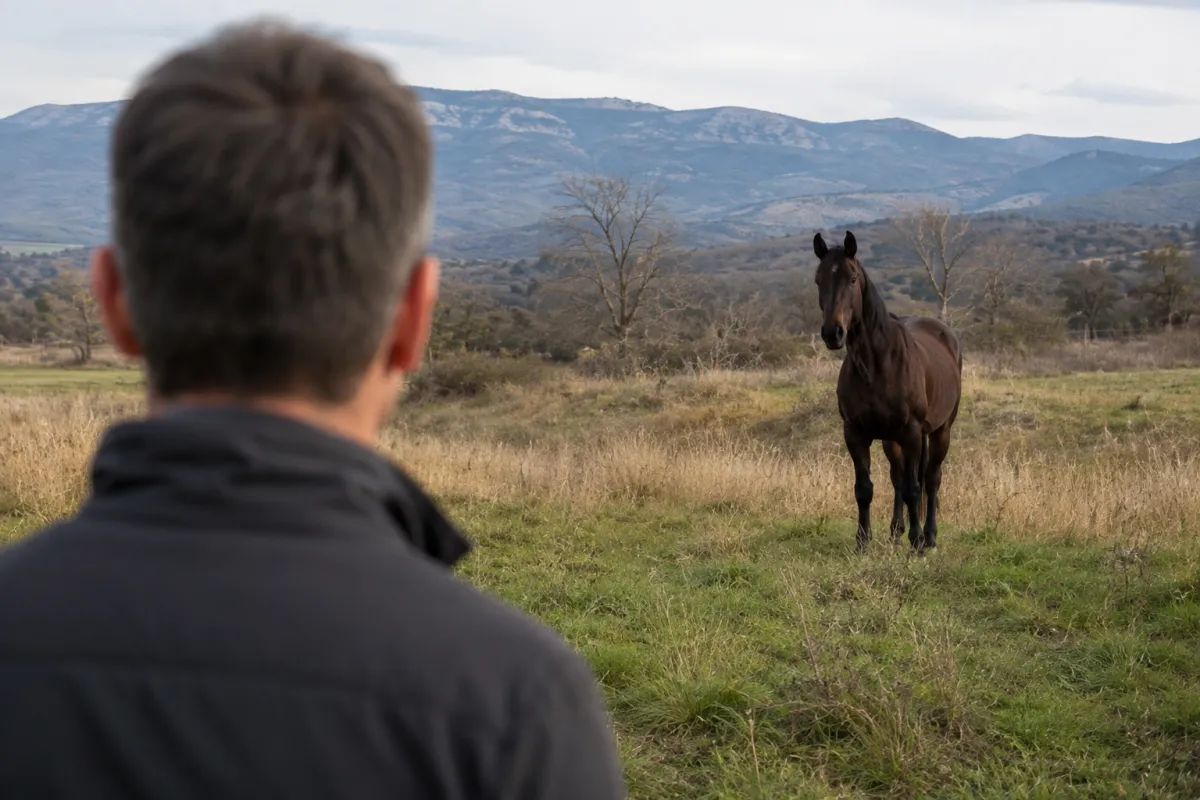
Here's an experiment I find incredibly revealing: stop. Don't correct, redirect, or ask for another behavior. Just give your horse a little space and watch what they choose to do.
Do they come closer? Move away? Return to grazing? Look around? Approach another horse? Stand quietly?
Sometimes the clearest communication happens when we aren't asking the horse to do anything at all. When there is no request to answer, we get to see more of the horse's own choices. And those choices can tell us a great deal.
Don't Assume You Have to Fix Everything
This may be the hardest part. We are accustomed to thinking that if a horse behaves in a certain way, there must be something we need to correct. But not every behavior is a problem. Sometimes your horse is telling you a preference. Sometimes they're telling you they're uncomfortable. Sometimes they're responding to something you haven't noticed. Sometimes they simply want to be left alone.
And sometimes you won't know exactly why.
That's okay. We don't have to solve every mystery in order to respect what we're seeing. A horse can have an experience we don't fully understand and still deserve to have that experience taken seriously.
What If Your Horse Is Saying No?
This is where listening becomes more than an interesting skill. If your horse turns away, steps back, hesitates, or becomes tense, we have a choice. We can see it as resistance and try to overcome it, or we can become curious.
What are they saying no to?
Maybe it's the thing we're asking. Maybe it's the way we're asking. Maybe it's the timing. Maybe they're uncomfortable. Maybe they're frightened. Maybe they simply need more space.
We won't always know immediately. But giving the horse's answer a place in the conversation changes the relationship.
The Horse Is Always Talking
Not literally, of course. But the horse is always responding to the world around them. Their body changes with their experience. Their attention moves. Their breathing changes. They approach, retreat, investigate, relax, tense, connect, and disengage. We're part of that conversation whether we're paying attention or not.
The question is whether we're listening.
I don't think the goal of understanding horses is to become so good at reading them that we can predict and control everything they do. I think the goal is almost the opposite: to become quiet enough to notice, curious enough to wonder, and humble enough to admit when we don't know.
Perhaps the most important thing we can teach a horse is not how to communicate with us.
Perhaps it's showing them that when they do communicate, we will listen.


