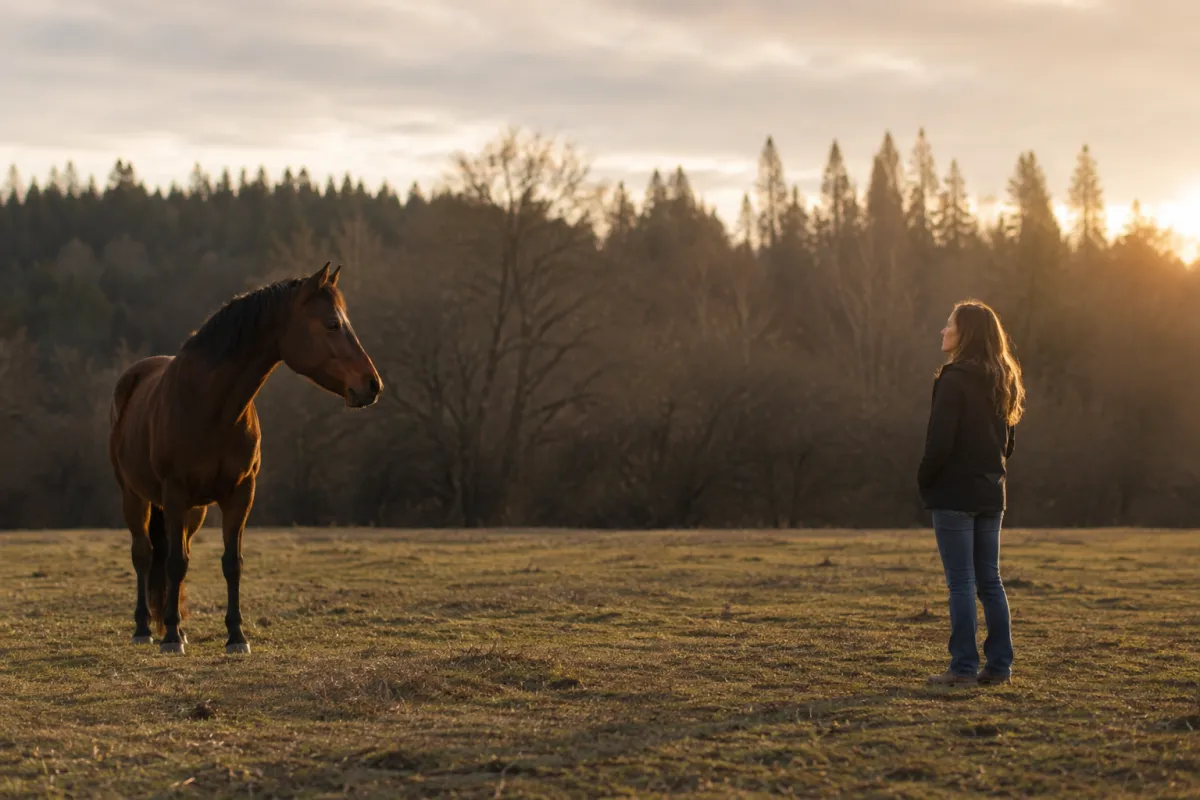
Can Our Relationship Be Deeper Than Obedience?
We tend to use obedience as evidence that a horse trusts us. The horse comes when called, stands when asked, moves when we ask, loads into the trailer, carries us quietly, and doesn't argue. When all of this happens, we often say, "He trusts me." But I've started wondering whether obedience actually tells us very much about trust.
A horse can obey because they understand what we're asking. They can obey because they've been rewarded. They can obey because they've learned that resistance doesn't work. They can obey because they're frightened of what happens if they don't. From the outside, those things can look remarkably similar. The behavior may be the same, while the experience of the horse is completely different.
So what if we're measuring the wrong thing?
What Does Obedience Actually Tell Us?
Obedience tells us that a horse does what we've asked. That's useful information, and there are certainly situations where we need horses to respond to us, particularly when safety is involved. A horse who can stop, move away, stand still, or follow a cue may be much easier to keep safe in a complicated world.
But obedience doesn't necessarily tell us how the horse feels about the interaction. A horse can do something willingly, reluctantly, or because they've learned that saying no isn't an option. The outward behavior may be identical, but the experience isn't.
A horse can obey you without trusting you.
That may be an uncomfortable thought, but I think it's worth sitting with.
What Happens When We're Not Asking?
I've become increasingly interested in what my horses do in the spaces between requests. What do they do when I'm not asking anything? Do they approach me when they don't need anything? Do they choose to stand beside me when they could be somewhere else? What happens when I stop? What happens when I give them the opportunity to leave?
These moments are interesting because there is less for the horse to simply comply with. There is an opportunity to see what they choose when there isn't a human instruction waiting for them.
And choice tells us something that obedience can't.
A Horse Who Says Yes Is Different From a Horse Who Has Learned Not to Say No
This distinction has become increasingly important to me. If a horse walks into the trailer because they've learned that resisting is pointless, we may call that success. If a horse walks into the trailer because they've become comfortable with the trailer and willingly follow us inside, that feels different.
The outward behavior may be exactly the same. But one is compliance, while the other is participation.
This is why I think we sometimes need to look beyond whether a horse does something and become curious about what happens inside the relationship while they're doing it.
What Happens When We Allow a No?
This is where things get uncomfortable. If my horse says no, what do I do? Do I immediately try to overcome the no, or do I pause long enough to wonder why it happened?
Maybe the horse is frightened. Maybe something hurts. Maybe they don't understand. Maybe I approached too quickly. Maybe they simply don't want what I'm asking right now. There are times when something genuinely needs to happen, of course. Horses sometimes need medical care. They sometimes need to be moved. Sometimes safety requires us to insist on something.
But even then, I can listen. I can make the experience less frightening. I can give the horse more information. I can change my approach. I can acknowledge that their resistance is telling me something.
Listening doesn't mean surrendering responsibility.
It means recognizing that the horse is part of the conversation.
Perhaps Trust Is Something Else
Maybe trust isn't a horse doing everything we ask. Maybe trust is a horse knowing that they can communicate with us without disappearing from the relationship.
They can hesitate. They can move away. They can tell us they're uncomfortable. They can have an opinion. And they can discover that we don't immediately become angry or forceful when their opinion differs from ours.
That kind of relationship asks something of us that obedience doesn't. It asks us to become trustworthy even when the horse isn't cooperating.
I think that's a much more interesting measure of trust than how quickly a horse responds to a cue.
The Horse Who Chooses You
There's a particular feeling you get when a horse comes to you when they don't have to. They could be grazing, standing with their friends, exploring the pasture, or doing absolutely anything else, and they choose to come over.
I don't think we should take that for granted.
Because that isn't obedience.
It's a choice.
And perhaps that is where the deeper relationship begins. Not when the horse learns to obey us, but when they have enough freedom to choose us.
What Are We Actually Trying to Build?
If all we want is a horse who responds correctly to our cues, obedience may be enough. But if what we want is a relationship, I'm not sure it is.
A relationship requires two beings. Two points of view. Two sets of preferences. Two participants. The horse shouldn't have to become human for their perspective to matter. We simply have to become willing to notice that there is another perspective in the relationship.
That changes the question from "How do I get my horse to do what I ask?" to "How can we find a way to do this together?"
Sometimes the answer will still be that the horse does what I ask. But sometimes the answer will be that I change what I'm asking. And sometimes the answer will be that we stop altogether.
That doesn't make the relationship weaker.
It may be the very thing that makes it deeper.
Because obedience can tell me that my horse will do what I say.
Choice can tell me something far more meaningful:
what my horse wants to do when I give them the opportunity to choose.


